How Long Is a KBO Game? The League's Own Table Says 3:06
The KBO cut two seconds off its pitch clock for 2026. Games got longer anyway. Korea's league publishes its own average-game-time table, and when I opened it on the evening of September 17 KST it read 3 hours 6 minutes for regulation nine innings, against 3:02 for all of last season.
Two numbers, four minutes apart.
The league's own table, not the headline number
KBO's 평균 경기시간 page carries two yearly tables, and they do not say the same thing. One is labelled 정규이닝, regulation innings, and starts at 2010. The other is 연장포함, extras included, and runs back to 1982.
Read down the 정규이닝 column and you get 3:12 in 2023, 3:10 in 2024, 3:02 in 2025, and 3:06 so far in 2026. The 연장포함 column runs three or four minutes longer in every one of those years, at 3:16, 3:13, 3:05 and 3:09.
The long view lives in that second table. KBO games sat under three hours through most of the 1980s and 1990s, and the floor is 2:47 in 1993. Every season from 1999 onward is above three hours. The peak is 3:27 in 2014. So the pitch clock was not fixing something that appeared out of nowhere. It clawed back roughly two decades of creep, and this season has handed four minutes of that back.
A club-by-club table sits above the yearly ones, with no year label on it that I could find. Its regulation-inning column runs from 3:00 to 3:12, a twelve-minute spread between the quickest club and the slowest. Whether this year's extra four minutes are spread evenly across the ten clubs or concentrated in two or three bullpens, that table cannot tell you without a year on it.

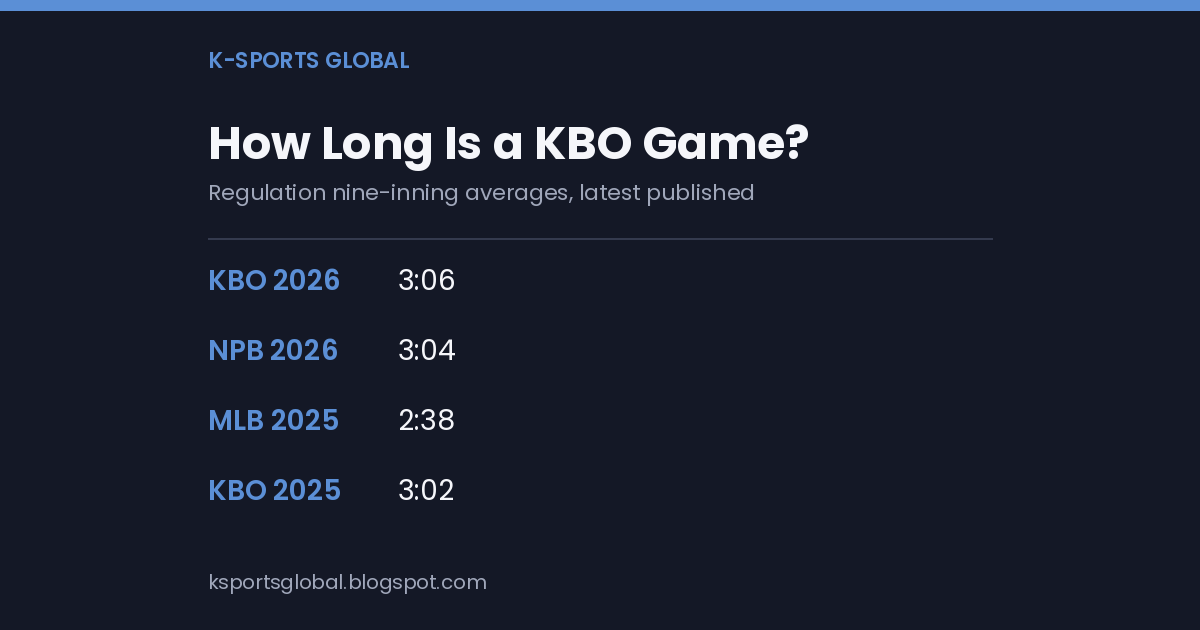
Korea and Japan swapped places this year
NPB publishes the same statistic in the same place, and its page prints two figures per row. The plain number is nine-inning games only. The bracketed one is every game played. As of September 16 the combined figure reads 3:04 (3:09), drawn from 709 nine-inning games out of 779.
Last season NPB finished at 3:05 (3:11) across 753 nine-inning games of 858, with the Central League at 3:05 and the Pacific at 3:04. The 2024 figure on the same page is 3:02. Japan slowed by three minutes across 2025 while Korea sped up by eight.
Line the two 2026 numbers up and Korea is the slower league by two minutes. If you have been repeating that Japanese baseball is the plodding one, it stopped being true this year.

MLB is the outlier, and it is drifting back too
People argue about the American gap most, and it holds up. The Associated Press reported on September 29, 2025 that the average nine-inning MLB game rose by two minutes to 2:38. It was 2:36 in 2024, the lowest since 1984's 2:35, and 2:40 in 2023, the first year of the clock. Three nine-inning games ran 3:30 or longer in 2025. In 2021 there were 391 of them.
Korea's 2026 figure sits at 3:06 against MLB's 2:38 for last season. Twenty-eight minutes, and nobody here calls that a rounding error.
MLB is moving the wrong way too. Tom Verducci wrote on April 29, 2026 that the season's first 421 games averaged 2:43, against 2:37 through the first 421 a year earlier. He puts 63 seconds a game on the ABS challenge system, at an average of 4.1 challenges per game, while arguing ABS is not the main driver; he also points to higher pitch counts, pitchers using more of the clock, and more batter timeouts. I could not open a full-season 2026 figure from MLB itself, so 2:43 is an April snapshot and nothing more.
What ate the two seconds
Yonhap's Jang Hyun-gu covered this on August 24. He wrote "올 시즌 정규 이닝 평균 경기 시간은 3시간 6분으로 되레 작년보다 4분 늘었다", meaning this season's regulation-inning average is 3 hours 6 minutes, four minutes longer than last year instead of shorter. In the same piece he restates the change it is measured against, "피치클록 투구 간격을 주자가 없으면 18초로, 주자 있으면 23초로 2초씩 단축했다". Eighteen seconds with the bases empty, 23 with runners on, two seconds off each.
The week he was writing about, August 18 to 23, averaged 3:13 over nine innings and 3:15 with extras, and Hanwha Eagles games ran the longest of the ten clubs at 3:27.
His answer is bullpens, and I think he has it. Relief pitchers across the ten clubs posted a 7.10 ERA that week against a season mark of 4.96. Walks and pitching changes eat far more clock than two seconds per delivery can give back. None of the rest of the 2026 package shortens an inning either. The automated strike zone is set at 55.75% of a batter's height at the top and 27.04% at the bottom, and each club carries two check-swing video reviews with one more available in extra innings.
How to check any of this yourself
The three leagues do not publish the same statistic, and the same league's number can mean different things depending on when in the season it was taken. Two pages carry the originals.
- KBO: the 평균 경기시간 page. 정규이닝 means nine innings, 연장포함 includes extras, and both tables update through the season.
- NPB: 試合時間 by year. The plain figure is nine-inning games, the bracketed one is all games, and swapping the year in that URL pulls any past season.
MLB publishes nine-inning games only. The honest comparison is MLB against KBO's 정규이닝 column, never against 연장포함.
One 2025 figure still circulating is not a season figure at all. SBS reported on June 30, 2025 that games to that point averaged 3 hours 2 minutes including extras and 2 hours 59 minutes over nine innings, and noted that the last time the average sat at or under three hours was 1998, at 2:59. That was a half-season number, taken after the games of June 29. KBO's finished 2025 row reads 3:02 over nine innings and 3:05 with extras, so the season ended above three hours even though it spent its first half under. If you see 2:59 quoted as Korea's 2025 average, that is the June figure, not the final one.
The regular season finishes on October 7. At 3:06 the 2026 row would be the second-lowest figure in the 정규이닝 table, level with 2012. That row gets its final value on October 8, and I have no idea which side of 3:06 it lands on.
This is a running news series, not a one-off post — new stories go up twice a day, roughly 7am and 7pm Korea time.
More Korea coverage from our network: Hallyu Now · Korea Travel Planner · Korean Table · Seoul Skin Notes


Comments
Post a Comment