KBO Just Broke an Attendance Record, and It's Free to Watch
Every press release out of the KBO (Korea Baseball Organization) this season leans on the word "record." Usually that kind of self-praise deserves a raised eyebrow. This time the actual numbers undersell it.
The league hit 9 million fans in 505 games on Aug. 11 — the fastest any KBO season has reached that mark, 23 games quicker than 2025's pace, according to the Korea Herald. Fifteen days and 60 games later, it was 10 million, in 565 games, 22 games faster than the previous record, per Hankyung. League-wide seat occupancy was already running at 86.7 percent through late July, up from 82.2 percent at the same point last year, with average attendance climbing to nearly 18,000 a game — Korea Herald's numbers again.
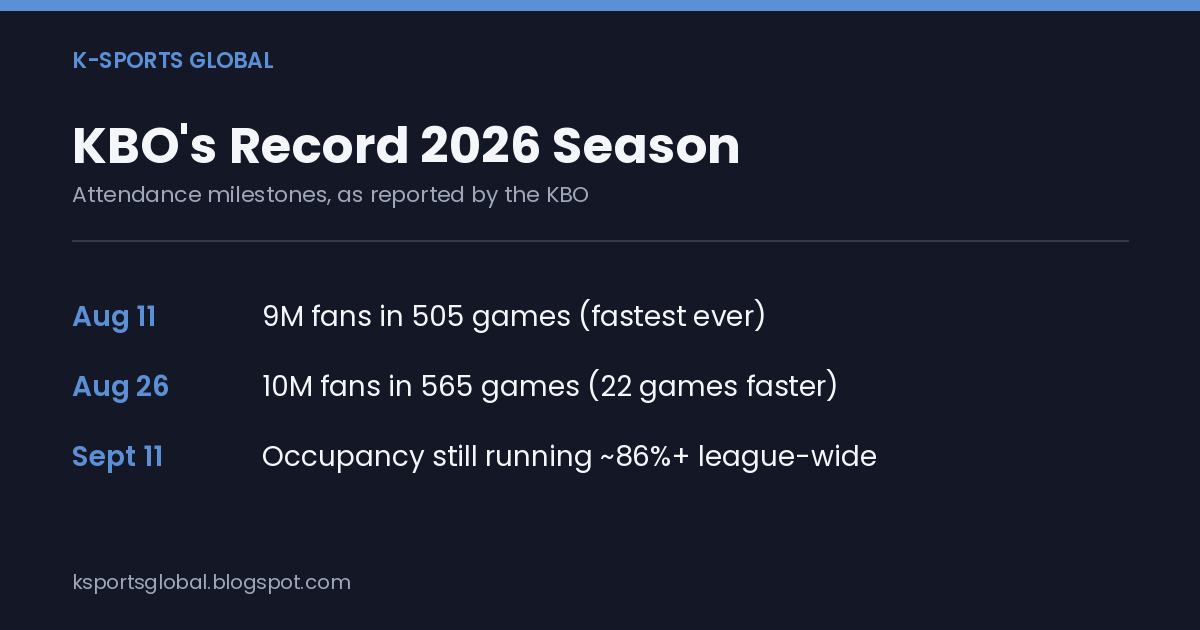
The Fastest 10 Million in KBO History
Context makes this weirder than it sounds. This isn't a league discovering baseball for the first time. The KBO topped 10 million spectators in each of the last two seasons too. What's new is the pace. Every single cumulative benchmark this year, from the first million on up, has been the quickest ever recorded. A five-day break in early August for extreme heat didn't even slow it down.
Samsung Lions and Hanwha Eagles have been driving a chunk of that: Samsung led the league in seat occupancy at 97 percent-plus through the summer, and Hanwha racked up more sellouts than any other club. Neither of those teams was drawing numbers like this five years ago, which tells you this is closer to a genuine cultural shift than a one-city bump.

A Pennant Race That's Earning the Crowds
None of this happens without a real race, and September has one. Samsung Lions and KT Wiz are separated by essentially nothing at the top of the standings as of Sept. 11, per Wikipedia's live season page, with LG Twins, Kia Tigers, and Doosan Bears all still close enough behind to matter for the final wild-card spots. That table will look different by the time you read this. It's a moving number, not a fixed one, and the regular season runs through Oct. 7.
That's the actual driver here, more than any marketing push. A tight finish sells tickets in Korea the same way it does anywhere else.
Who's Filling the Seats
Here's the detail that gets buried under the raw attendance figures: women made up 56.7 percent of KBO's ballpark crowds last season, up from 42.1 percent back in 2017, according to industry data cited by Daum News. That's not a small shift for a sport that spent decades marketing almost entirely to men.
Streaming tells the same story from a different angle. TVING, the domestic streaming rights holder, says its KBO viewership jumped roughly 30 percent year over year this season, after an 8 percent bump the year before. Women now make up 43 percent of that audience, and women in their 20s actually outnumber men in the same age bracket, per the Seoul Economic Daily. Merchandise spending has followed: one home-shopping platform's KBO collaboration goods drop in April beat its launch-day order target by 333 percent, and KBO items took seven of the top ten spots on that platform's own bestseller ranking, per Daum News. The wider annual economic effect of the fan boom, per a Hyundai Research Institute estimate cited in the same report, is roughly 1.11 trillion won, a little over $800 million at current exchange rates.
None of that is why a Samsung–KT series in September fills a stadium on a Tuesday night. But it's a decent answer to "why is this happening at all," and it's the kind of shift that usually shows up in a league's attendance five years before anyone writing about baseball notices it.
How to Watch a KBO Game From Outside Korea
SOOP has held the KBO's international streaming rights since 2024, and the deal runs through this season. Every game is free to watch for fans outside Korea, confirmed by the Korea JoongAng Daily. That closed a real gap: after ESPN dropped its KBO coverage once MLB resumed play in 2020, international fans had no legitimate option for three full seasons.
Timing is the part people underestimate. A typical KBO weeknight game starts at 6:30 p.m. KST, which lands around 5:30 a.m. Eastern and 10:30 a.m. in the UK. Weekend games start earlier, at 5 p.m. KST — still 4 a.m. Eastern, but a slightly more forgiving 9 a.m. in the UK. If you're not setting an alarm, SOOP's highlights and on-demand replays are the realistic way to keep up.
I'll admit the streaming side is the one part of this I haven't tested myself past a few highlight clips, so take the "free and reliable" claim as reported rather than lived experience on my end.
Ten million-plus is close to a formality at this point. Whether 2026 actually clears last year's full-season total comes down to how the next three weeks of games get scheduled around any more heat delays — and KBO Septembers have a habit of throwing at least one of those in.
This is a running news series, not a one-off post — new stories go up twice a day, roughly 7am and 7pm Korea time.
More Korea coverage from our network: Hallyu Now · Korea Travel Planner · Korean Table · Seoul Skin Notes


Comments
Post a Comment