Three Korean fighters, six gold medals, and MMA's first Asian Games
Mixed martial arts has never produced a medal at the Asian Games. That ends on Sunday at the Nagoya City Inae Sports Center, where six gold medals are decided over three days. Korea entered three of the six weight classes and left the other three empty.
The three fighters left Incheon International Airport on the morning of 17 September, according to the Korean daily Kyungje Ilbo, whose report ran that afternoon. Yoon Tae-young, Choi Eun-seok and Lee Bo-mi travelled with head coach Kim Geum-cheon and senior coach Kwon A-sol, the former Road FC lightweight champion. The same report has them going through acclimatisation training and the draw before competition opens on the 20th, so the bracket was still unset when they flew.
All times below are Japan Standard Time. Japan and Korea keep the same clock, so Korean readers can take every date here at face value, and everything is accurate as of 07:00 KST on 18 September 2026 (22:00 UTC on the 17th).
The Olympic Council of Asia put this in writing in Nagoya on 2 May 2025. MMA "will appear in the Asian Games for the first time in history," the release says, as a discipline under combat sports, with "six events – four for men and two for women." The full OCA statement bundled that decision with cricket's return to the programme.
The cage is gone, and so is the third round
If you have only ever watched MMA in a fenced cage, start with the floor. AMMA runs the competition, and its adult competition ruleset, the version dated 3 April 2024 on the federation's site, describes a raised square platform 0.6 m high with 18 m sides, topped by a 14 m cushion. Inside that sits the live area, "a regular octagon with a diameter of 10 meters," ringed by a 2 m protective zone. The boundary is a line on the mat.
In a pro bout the fence keeps fighters inside. In Nagoya nothing physical stops them, so the referee counts. Under the same rules, a bout ends when "one side goes out of bounds three times in a single round." The count resets each round. Take a fighter whose entire takedown game runs on walking an opponent backwards into chain-link, and you have three days between landing and the first bell to solve it.
The fights are shorter than anything on a pro card. Two rounds instead of three, at 3 minutes each in the preliminaries and 5 minutes each in the finals, with a 1-minute break between them. Kyungje Ilbo reported the same round and minute counts. The organisers have not posted a separate Asian Games ruleset, so that was the only cross-check I could run.
Scoring runs on technical points that accumulate through the round rather than on a judge's holistic read of it. A clean strike is worth 1 point. A legal throw to the ground is 1. A submission the referee judges to be near completion is 2, and so is a strike that visibly rocks an opponent toward a knockout. Control with no strikes scores nothing, and I expect that to push the gi bouts toward throws and chokes instead of positional holding. The side referees then turn the points gap into a round result: 10:9 up to a ten-point margin, 10:8 beyond that, 10:7 beyond twenty.

Six classes, split between gi and no gi
The programme splits into two styles. Traditional MMA is fought in a gi, and per MK Sports the rules allow gi-grip throws and collar chokes. Modern MMA is shorts and a rash guard, the format an international audience already knows. Every competitor wears a mouthguard, gloves of 4 oz or heavier, and shin guards; men add a groin protector.
The six Asian Games classes, as MK Sports listed them on 2 September: men's modern 60 kg and 71 kg, men's traditional 65 kg and 77 kg, women's modern 54 kg, women's traditional 60 kg. AMMA's own rulebook carries eight men's and four women's classes in each style. Nagoya gets a thin slice of that.
Korea filled three. Yoon goes in men's traditional 77 kg, Choi in men's modern 71 kg, Lee in women's modern 54 kg. Lee finished third at the final qualifier and Choi third at the first, per MK Sports. Yoon got in on a spare quota the Korean federation secured from AMMA, so the inaugural Road FC welterweight champion is in Nagoya on an extra place.
Gordon Tang, who presides over both AMMA and its world body FIMMA, called the Games "a defining moment for Mixed Martial Arts" in a federation update carried by FightBook MMA on 29 July. That update put the field at 59 athletes from 23 National Olympic Committees, with 33 international and 14 national technical officials appointed. Those were July figures and I have not found an updated entry list.
A national team without a national training centre
The administrative side is thinner than the sporting one. The Korean Sport and Olympic Committee granted the Korea MMA Federation "temporary associate member" status at its 15th board meeting on 15 May 2026, MK Sports reported, under a membership rule that asks for at least one provincial body to be registered when the sport is on the Asian Games programme. AMMA gave the Korean federation full membership two months later, in July.

That shows up in the preparation. Kyungje Ilbo reports the three could not use the Jincheon National Training Center and moved between gyms in Seoul, Gwangju in Gyeonggi Province and Wonju in Gangwon Province, leaning on cheap lodging and sponsorship to cover costs. The same report says they sharpened live technique with former UFC fighter Jung Chan-sung.
MK Sports wrote that the delegation is targeting three bronzes.
The fighters themselves have said gold.
Both can be true at once. I would take the federation's number as the honest read, given a three-athlete squad against 23 NOCs, though Yoon at 77 kg in the gi is the entry I would least want to bet against.

When it runs, and where you can watch
Kyungje Ilbo lays out the three days: preliminaries and quarter-finals on 20 September, semi-finals on the 21st, finals by weight class on the 22nd. The hall seats 2,232, per MK Sports.
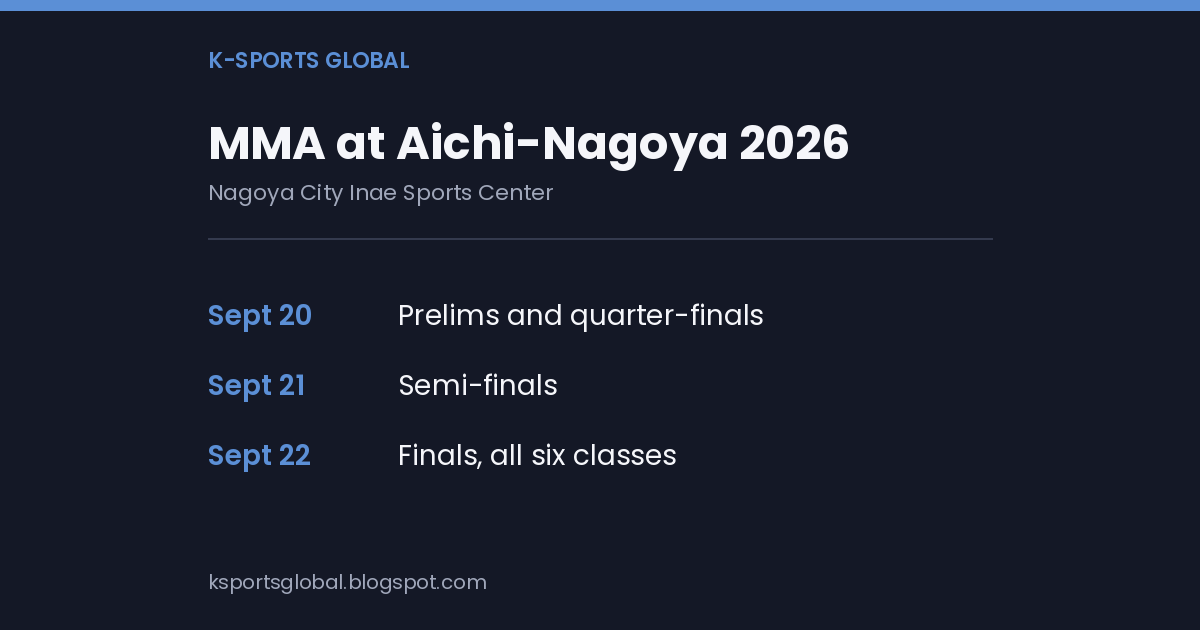
Session start times are the gap. They were not on the organisers' MMA page when I opened it. The Competition Schedule and Live Results links sit on that same page, so bookmark it rather than an aggregator's copy.
In Korea, SPOTV and SPOTV NOW hold the MMA coverage, and MK Sports reports it will be recorded rather than shown live. Korea's Asian Games rights sit with Eclat Media Group, resold to KBS, MBC, SBS, TV Chosun and Chzzk.
In the United States and Canada, Willow Sports is the exclusive home for roughly 700 hours of free coverage across three pop-up FAST channels called Asian Games 1, 2 and 3, carried on Fubo, Sling, Google TV, Xumo, Plex and others. Live windows run roughly 7 p.m. to 7 a.m. ET. Japan sits 13 hours ahead of US Eastern and 8 ahead of UK time this month, so a Sunday morning session in Nagoya lands on Saturday evening in New York.
For UK readers I have no answer yet. I checked the OCA site, the organising committee's own pages and general search, and found no announced UK rights holder for these Games. If you turn one up before Sunday, say so in the comments and I will correct this line.
This is a running series, not a one-off post — a new post goes up every day, at around 9am Korea time.
About · Contact · Privacy Policy
Read next: Son Heung-min Is Two Goals From Korea's Scoring Record · Korean Archery Team Trials, 64 Archers for 24 Places · Asian Games Gold and Korea's 34-Month Athlete Service Rule


Comments
Post a Comment