K League vs J League Attendance: 10,081 vs 21,246 a Match
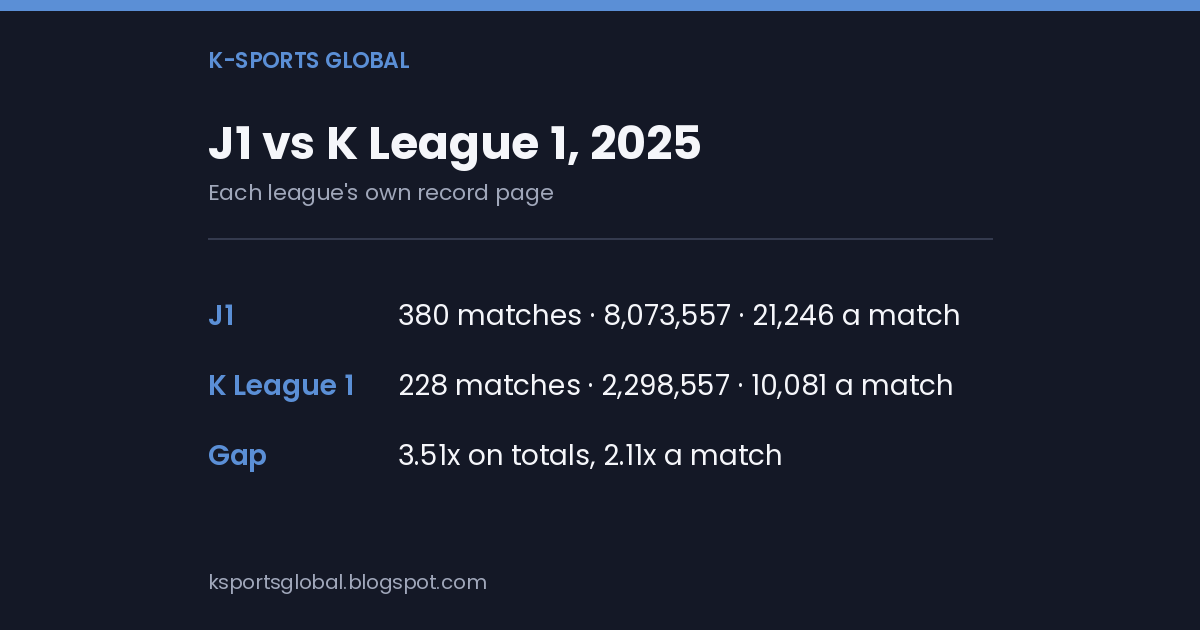
Any K League vs J League attendance argument ends up at the same two season totals. Japan's J1 drew 8,073,557 people in 2025. Korea's K League 1 drew 2,298,557. Both figures sit on the leagues' own record pages, and the ratio between them is 3.51 to one.
Per match the figures are 21,246 and 10,081, a ratio of 2.11. Half the headline gap is arithmetic about fixture lists.
Two leagues, two fixture lists
J1 has 20 clubs. In 2025 it played 380 matches, and the J.League Data Site puts the season at 8,073,557 admissions, 21,246 a match. K League 1 has 12 clubs. It played 228 matches, and the federation's own attendance page gives 2,298,557 and 10,081.
J1 therefore staged 1.67 times as many matches. Divide the ratio between the totals by the ratio between the fixture lists and 2.11 is what falls out, the per-match ratio again. I did that division myself on the two published tables; neither league prints the comparison. Over half of the headline gap is a 20-team league playing a 20-team schedule.
That K League figure also lands lower than the one the federation itself publicised in October. SBS reported the league's count on 18 October 2025 as 2,047,564 with an average of 10,341, which was the state of play once the 33 regular rounds were done. Subtract that from the final 2,298,557 and the five-round split left afterwards accounted for 250,993 across 30 matches, or 8,366 a game. The split rounds drew about a fifth less than the regular season that preceded them.
What each league counts when you walk in
The two federations are not measuring the same thing, and both of them say so in writing. The K League's competition regulations list what a home club must put on the big screen during a match. Article 13, clause 1, item 9 reads "공식 관중 수(유료 관중 합계, 후반전 15~30분 발표, 전광판 표출과 동시에 장내 아나운서 발표)." Official attendance is the paid total, announced between the 60th and 75th minute. The identical wording sits in the K League 2 regulations, and a league notice from 2024 dates the practice by calling it "유료관중 집계 시작(2018) 이후."
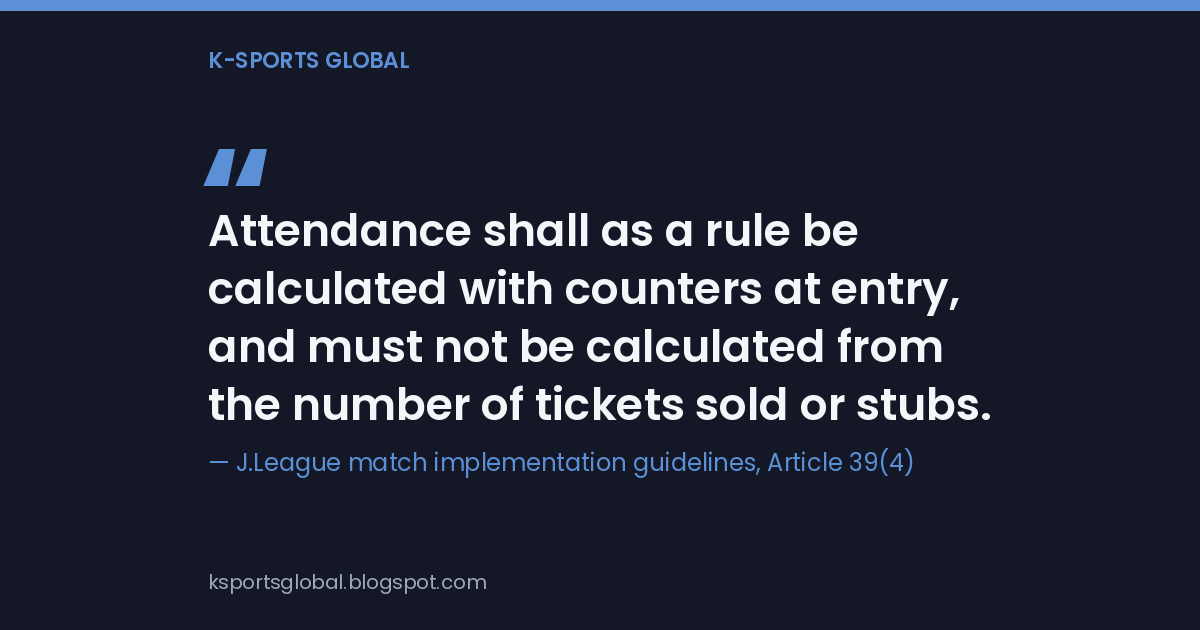
Japan's rule is in article 39 of the J1/J2/J3 match implementation guidelines, a PDF anyone can open. Clause 3 defines 入場者数 as the sum of spectators who came through the entrance holding an admission ticket, plus preschool children with no ticket, plus wheelchair spectators and their companions and guests in VIP seats who came in another way. The same clause bars everyone who works there from the count. "入場者数には選手、審判員、Jクラブの役職員その他試合運営に関わる者、スタジアム管理者、売店関係者、取材メディア関係者およびフォトグラファーは含めてはならない." Clause 4 then fixes the method. "入場者数は、原則として入場時にカウンター等を用いて算定するものとし、入場券の販売枚数や半券の数によって算定してはならない."
Counters at the entrance, in other words, and never a tally of tickets sold or stubs collected. Read the two clauses side by side and the difference is the word 유료. Korea's published number is the paid subtotal. Japan's counts everyone who walked in holding a ticket, whether they bought it or were handed it, because article 39 never separates the two cases.

I cannot tell you how many free seats sit inside the Japanese number, because neither the J.League Data Site nor the league's season review page breaks the two apart. What the rule does establish is that the Korean figure is a narrower measure by design, so the real crowd gap is somewhat smaller than 2.11 to one. Korea used to publish both numbers, and the federation's own 2017 mid-season release shows how far they can sit apart: Seoul averaged 16,390 through 23 rounds that year, of which 14,497, or 88.5 percent, were paying. Pohang came closest to all-paid at 96.9 percent, and only three other clubs cleared 90. MK Sports dates the switch to a fully paid count to 2018.
K League 1 is running 17 percent behind last year
The 2026 rows on the K League's own attendance page surprised me. Through round 30 of this season, K League 1 has drawn 1,521,782 across 179 matches, an average of 8,502. Through round 30 of 2025 it had drawn 1,853,368 across 180 matches, an average of 10,297. That is a drop of 17.4 percent at the same point of the calendar. Round 30 by itself brought in 42,578 this year and 79,698 last year.
Squad turnover explains some of the 17.4 percent and not much of it. Daegu and Suwon FC were relegated after 2025 and Incheon and Bucheon came up, and that swap is close to a wash. Daegu averaged 10,495 last season and Suwon FC 4,669, while Incheon are on 9,852 this year and Bucheon on 6,611. The falls are concentrated at the top of the table instead. Seoul averaged 23,185 across 2025 and are on 21,993 now, Jeonbuk 18,425 then and 16,133 now, Ulsan 14,465 then and 10,628 now. Those 2026 club figures cover 13 to 17 home matches apiece while the 2025 ones cover a full season including the split, so the club comparison is indicative rather than exact.
Jeonbuk are the one club moving the other way. The federation's second club awards of the season, announced on 18 September, went to them twice: "14∼26라운드에 열린 총 6번의 홈경기에서 평균 유료 관중 1만8237명으로 최다 관중을 기록했다," up from 15,134 over rounds 1 to 13.

What a Korean seat costs, if you are planning a visit
The 2025 gate take across both Korean divisions was 460억 9,132만 7,737원, which the federation's year-end release called the highest since official tracking began in 2013. Divided by heads, the average K League 1 club took 13,419 won per paying spectator, and the average K League 2 club 9,544 won. Seoul alone took 70억 3,749만 4,870원 at the gate.
For a visitor that is the useful line in the whole announcement. A K League 1 seat runs about 13,400 won on average, and availability will not be your problem. The best-attended match of 2026 so far, Seoul against Anyang on 5 May, drew 35,729 into a ground listed at 66,704.
Where these numbers live
Both leagues publish the raw tables, and that is the only reason this post exists. The K League's page at kleague.com/record/audience.do has a season selector running back to 2013, a club table, a round table and a searchable list of individual matches with the attendance for each. The J.League's equivalent at data.j-league.or.jp/SFTD12 splits by year and by competition, and the 2025 J1 row is where the 380, the 8,073,557 and the 21,246 above come from. The two rulebooks are both public as well, at kleague.com/about/competition.do and in the J.League PDF linked above.
If you want the same exercise for baseball, we did the KBO version earlier this month, where the league's own attendance record and its own table of game times tell a happier story than football's.
Three regular rounds and a five-round split are left in K League 1. Round 31 goes up on the same page.
This is a running series, not a one-off post — a new post goes up every day, at around 9am Korea time.
About · Contact · Privacy Policy
Read next: Son Heung-min Is Two Goals From Korea's Scoring Record · Moreno's First Training Camp Opens, and a Public Event Sold Out in 0.04 Seconds · Lee Kang-in's First Madrid Derby and Two Kickoff Times


Comments
Post a Comment